

After 2G and 3G, it’s now the copper network’s turn — the one carrying ADSL and the traditional landline — to disappear. Arcep and Orange are running a national shutdown schedule, town by town, with a stated goal: no copper line left anywhere in France by 2030. For many businesses, the question isn’t “if” any more, it’s “when” — and for a growing number of towns, the deadline is already very close.
A schedule already well under way
The shutdown happens in two stages, town by town: first the commercial shutdown — no operator can sell a new ADSL subscription any more — then, 12 to 24 months later, the technical shutdown, which permanently cuts existing lines. 162 towns had already switched over by January 2025, and a further 763 towns had their copper network permanently cut by the end of January 2026. A third batch of more than 2,100 towns is scheduled for permanent shutdown by 31 January 2027 — for every town in France, the commercial shutdown happens by that same date at the latest. In other words: if your town hasn’t shut down yet, it’s probably in one of the next batches.
Who is actually affected
- SMEs still on ADSL for their main internet connection — the technical shutdown cuts the line with no fallback if nothing has been planned.
- Secondary sites and warehouses, often lower priority in migration plans than head office, even though they sometimes depend entirely on a copper line.
- Backup lines — many businesses have an ADSL line as a fallback in case their main link fails; that backup line is disappearing too.
- Multi-site organisations, where each location depends on a different town, and therefore a different shutdown date — a real headache without an overall view.
FTTH fiber, or 4G where fiber isn’t there yet
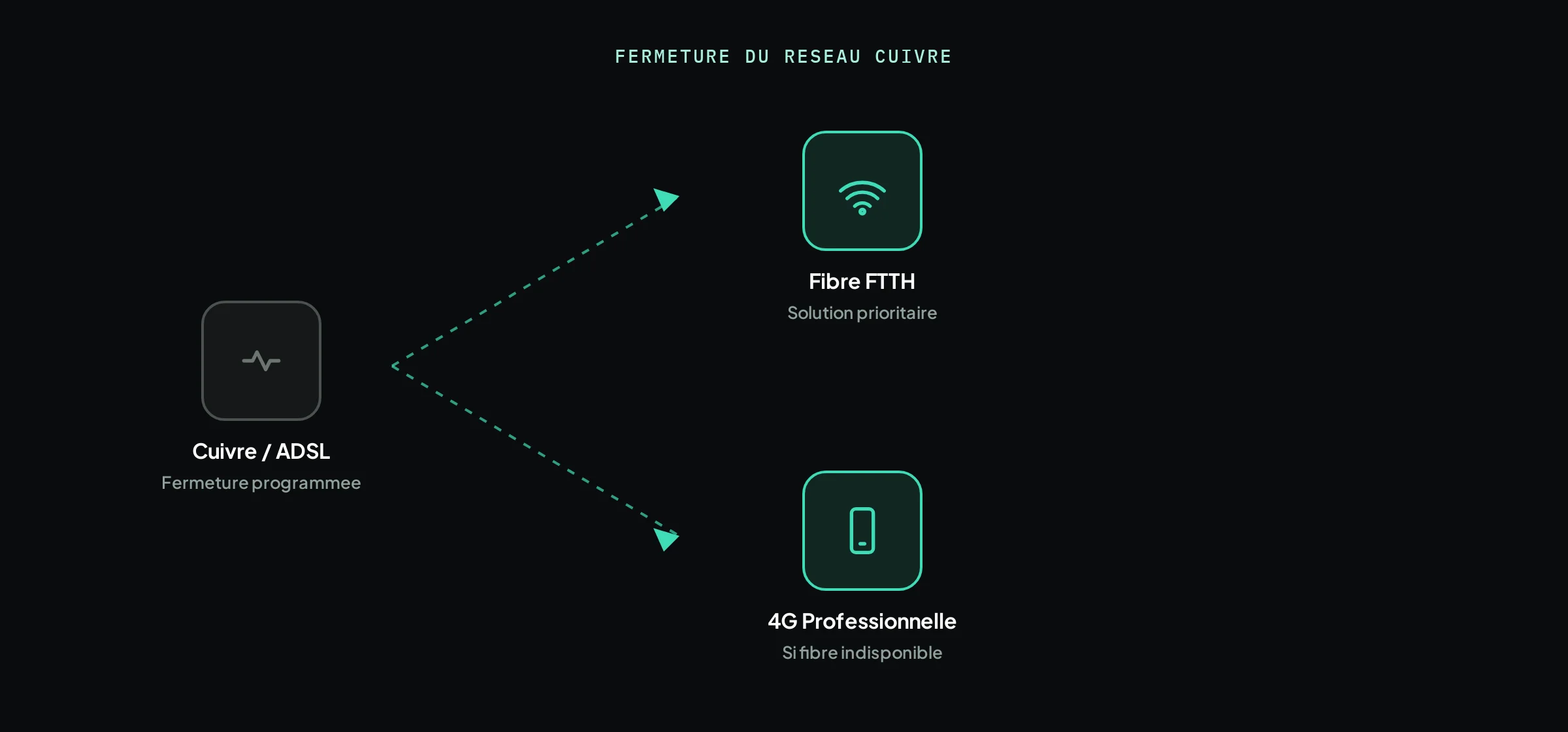
The good news: the copper shutdown is happening alongside the rollout of FTTH fiber, which is widely available in most of the towns affected. In the vast majority of cases, the best solution is simply to switch to fiber — significantly faster than ADSL, often for a similar or lower cost.
But some sites are still in a fiber dead zone by the time copper shuts down — a timing gap between the FTTH rollout and the copper shutdown, which isn’t always perfectly in sync town by town. In that case, professional 4G access steps in: robust enough to carry a site’s internet connection, either while waiting for fiber to arrive or as a long-term solution if the site is suited to it.
How to plan ahead without getting the date wrong
- Check the exact date of commercial and technical shutdown for each site, town by town — not a rough national estimate.
- Verify actual fiber eligibility at the address, not just on the theoretical coverage map.
- Switch over before the technical shutdown, not after — an early switchover avoids any service interruption, a last-minute one doesn’t guarantee it.
- Plan a 4G fallback wherever fiber isn’t available yet, rather than facing an abrupt cut-off.
As an internet service provider, GET Conseil has FTTH and professional 4G solutions ready to deploy — not just an audit that refers you to a third party, but directly operational access, including for sites that need a mobile connection while waiting for fiber (see our fixed 4G/5G internet for rural areas offer).
Conclusion
The copper network will disappear entirely by 2030, and the pace of shutdowns is accelerating — several thousand more towns are already scheduled for 2027. Planning the migration ahead, town by town and site by site, avoids discovering the cut-off on the day it happens.
Do you still have one or more sites on ADSL? Let’s talk — we’ll check your town’s shutdown date and set up the right solution, fiber or 4G, in Roubaix and across Hauts-de-France.