

Across France, mobile operators are preparing to switch off their 2G and 3G networks in favour of 4G and 5G — the shutdown is now scheduled for the coming weeks, leaving very little time to act. The problem: a huge number of devices installed 10, 15 or 20 years ago still communicate only over 2G, often without their owners even realising it, until the day the connection simply stops working — with no prior warning. This is an emergency to deal with now, not a project to schedule for next year.
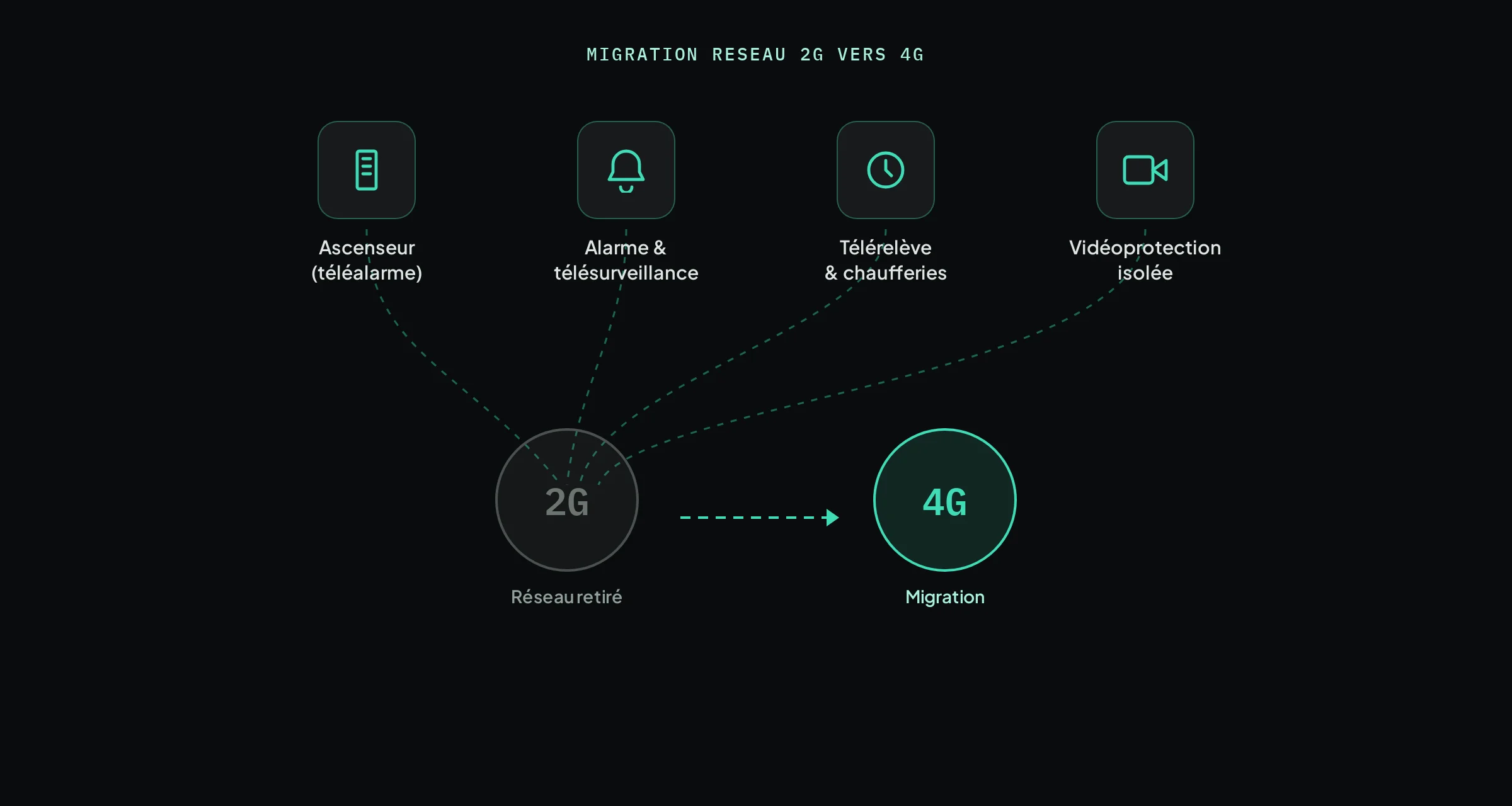
Why 2G and 3G are disappearing
Running several generations of network in parallel is expensive for operators, for a use case that’s becoming less and less justified: smartphones moved to 4G/5G long ago. So operators are reallocating 2G/3G frequencies to the more efficient 4G and 5G networks — and the timeline for this switch is now set at just a few weeks away. For an end user with a recent smartphone, this switch is invisible. For an industrial or technical device that only communicates over 2G, it means an outright loss of connection the moment the shutdown takes effect, with no automatic fallback possible.
Lifts: a regulatory requirement
This is probably the most critical example. The EN 81-28 standard requires a lift to have a permanent emergency call link, allowing someone trapped in the cabin to reach an emergency service 24/7. A large share of the French lift fleet uses a simple 2G GSM module for this, installed when the building was built or last brought up to standard. When 2G is switched off in an area, this link goes down — the lift stays in service, but with no working emergency call system, which exposes the owner or managing agent in the event of an inspection or incident.
Alarms and remote monitoring
Intrusion and fire alarm panels transmit their events to a monitoring company, often via a GSM card backing up the landline or ADSL connection. Many of these cards are still on 2G. The risk here is silent: the system keeps showing “connected” locally while transmission to the monitoring centre has stopped working — the day an intrusion happens, the alert never goes out.
Remote meter reading and boiler rooms
Remote water meters, communal boiler room sensors, temperature control in schools and apartment buildings: this technical equipment sends its data via a GPRS/2G module, often installed and then forgotten about for years. The 2G shutdown cuts off the data feed — without physically breaking the equipment, which keeps working “locally” but becomes invisible remotely.
Video protection at standalone sites
When a camera or recorder is installed at a site with no reliable fixed-line access — an outdoor car park, a technical site, a rural area — the connection frequently runs over a 2G/3G SIM card. This is a case where migrating to 4G is also an opportunity: 4G speeds allow for far better video quality than 2G could ever carry.
How a migration works
The method stays the same whatever the equipment:
- Inventory — identify every piece of equipment communicating over 2G/3G on the site (often more numerous than a first look suggests).
- Verification of actual 4G coverage at each piece of equipment’s location — not just on the operator’s map.
- Replacing the communication module or router, while keeping the main equipment (lift, alarm panel, regulator), which doesn’t need to be changed.
- End-to-end testing — actually triggering an alert or a reading to confirm the information reaches its destination.
Done in this order, the replacement usually happens with no prolonged service interruption — but with a shutdown deadline set just weeks away, every day counts to identify and replace the equipment concerned before the failure, not after.
Conclusion
Lifts, alarms, remote meter reading, video protection: what these devices have in common is that they work silently, year after year, until the 2G connection they rely on disappears — often with no prior warning. The shutdown is now scheduled for the coming weeks: this is no longer something to plan calmly for later, it’s an emergency.
Do you manage one or more devices still connected over 2G/3G? Discover our 2G to 4G Migration offer — we support you from the equipment audit through to module replacement, in Roubaix and across Hauts-de-France.