
You’ve already turned your home into a little control centre: Home Assistant or Jeedom runs the shutters, heating and lights, your iPhone controls everything from the sofa, and the Tesla charges in the garage. The question coming up more and more in home automation communities isn’t “how do I automate” any more, it’s “how do I make all this genuinely smart”. Here’s where AI actually changes things in 2026 — and where it’s still not useful.
A voice assistant that stays home: Assist, Whisper and Piper
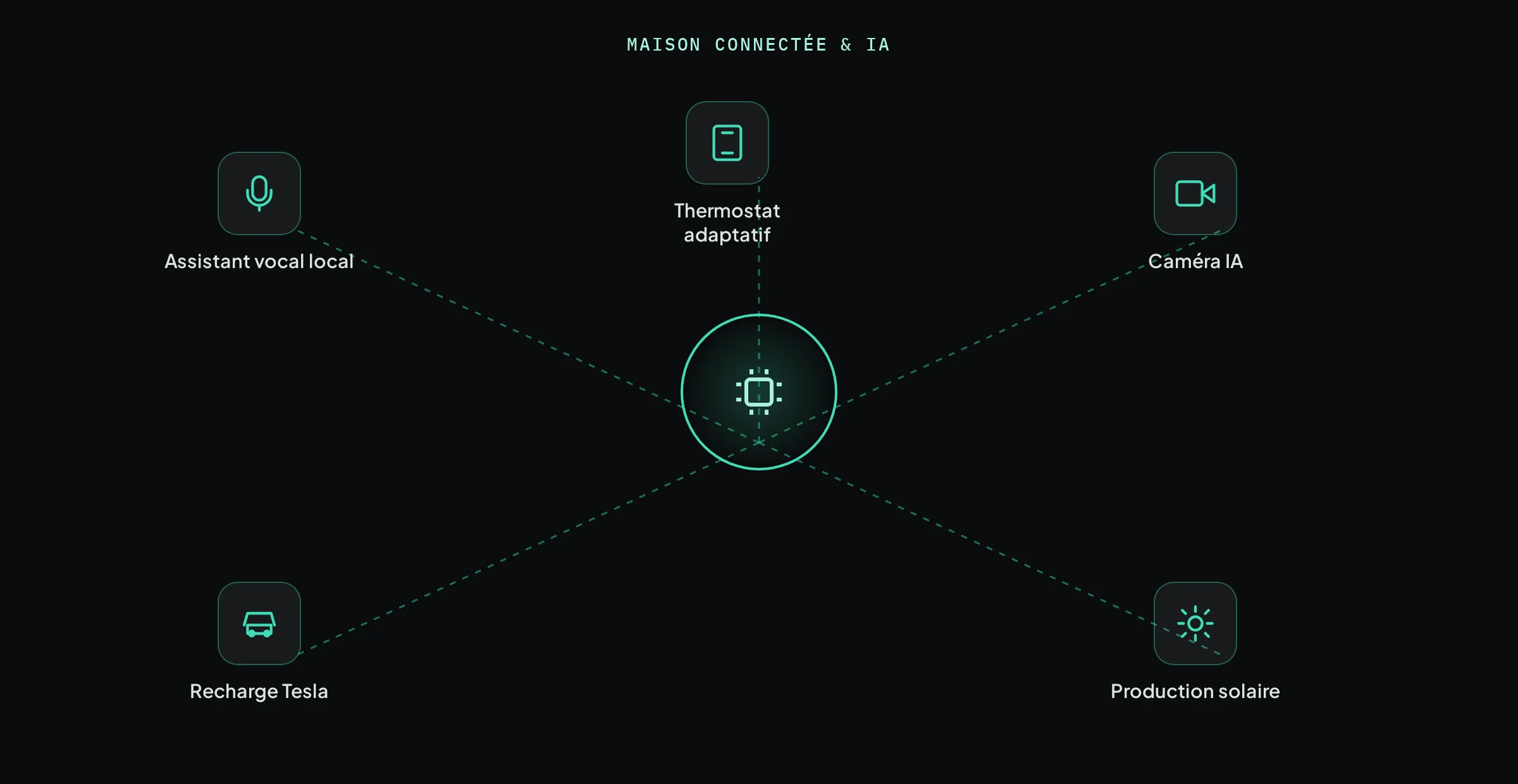
If you already use Home Assistant, you’ve probably come across Assist, its built-in voice assistant. Paired with Whisper (speech recognition) and Piper (speech synthesis), it runs entirely locally, on a Raspberry Pi or a dedicated mini-PC — no request ever leaves for Amazon or Google. That’s the real difference with Alexa or Google Home: you keep full control of your data, and the assistant can be trained specifically on your room names, your scenes and your own vocabulary.
The real step up comes from adding a local LLM (Ollama, for example) as an understanding layer: instead of rigid commands (“turn on the living room light”), you can say “it’s a bit dark for reading”, and the assistant translates the intent into an action. It’s still imperfect, but it’s the direction the whole open-source ecosystem is heading.
Cameras that understand what they’re filming
Traditional motion detection triggers an alert every time a cat walks by, a branch moves, or a car drives past on the street. AI-based detection changes that completely:
- Frigate, natively integrated with Home Assistant, runs object detection locally (person, vehicle, animal, package) — including with hardware acceleration on a Coral TPU or a GPU, for near-zero latency.
- Synology NVRs now include their own smart recognition (person vs vehicle vs animal, exclusion zones), directly usable in your Home Assistant automations via their native integration.
The concrete result: a notification only when someone approaches the gate after 10pm, not 40 times a day for the neighbour’s cat.
Tesla, solar power and smart energy management
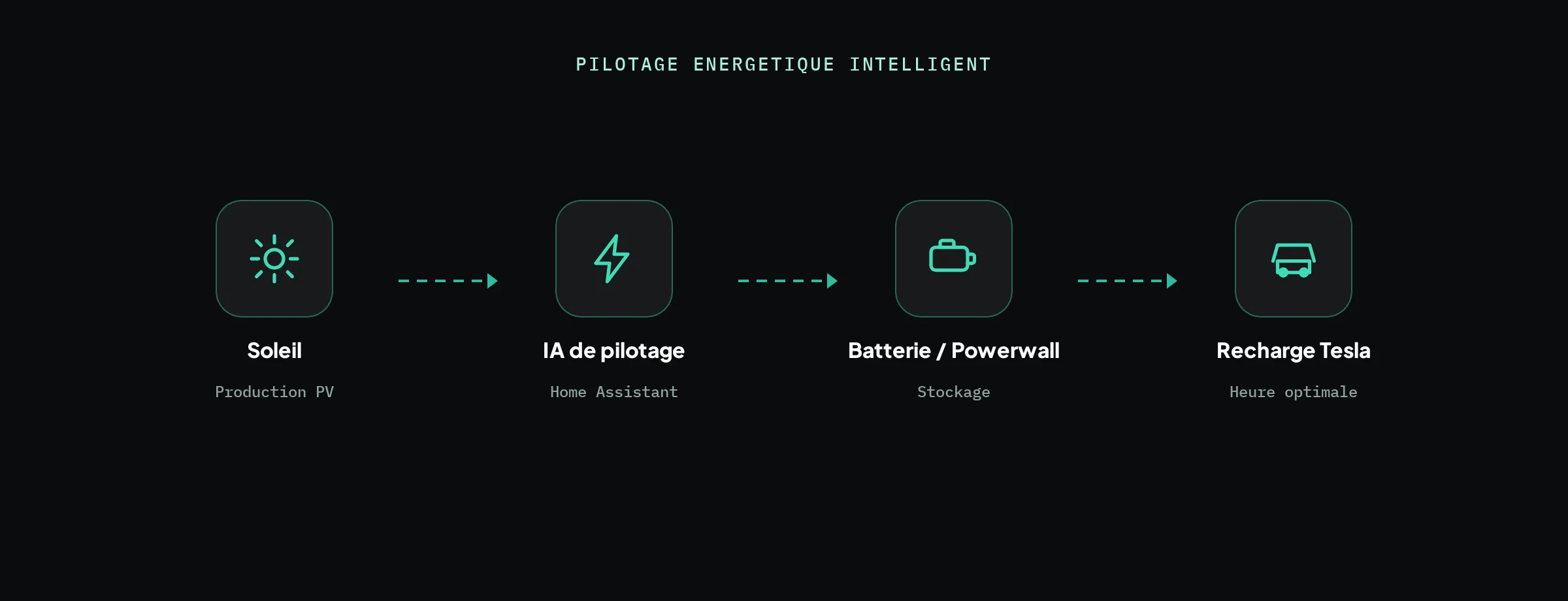
This is probably the most cost-effective use case for a Tesla owner with solar panels or a Powerwall: Home Assistant’s Tesla integration exposes charge level, solar power output and your supplier’s dynamic rates. A well-designed automation can then decide on its own to start charging only when solar is producing a surplus, or during the hours when electricity is cheapest and least carbon-intensive — without you having to think about it.
The same principle applies to heating: instead of fixed time slots, the system learns your actual presence patterns (via phone geolocation, presence sensors, or simply usage history) and pre-heats a room before you arrive rather than after.
Apple, Matter and everyday simplicity
If your life already runs on the Apple ecosystem, the good news is that Matter (the standard backed by Apple, Google and Amazon) is making Home Assistant and Jeedom increasingly interoperable with HomeKit. You can keep Siri and the Home app for quick everyday control, while letting Home Assistant handle the complex logic and AI in the background — the two worlds are no longer mutually exclusive.
What AI doesn’t do (yet)
To stay honest: local AI is still computationally demanding (a decent LLM needs a real GPU or a cloud subscription), fine-tuning Frigate or a local LLM takes time, and a poorly calibrated “smart” automation can quickly become more annoying than useful — heating that anticipates badly, alerts that miss what matters. AI amplifies a good installation; it doesn’t fix home automation that was poorly wired or poorly designed in the first place.
Getting started without losing every weekend to it
Everything above is fully doable on your own if you enjoy getting your hands into YAML. But between calibrating a detection model, the Tesla/solar integration, and the network robustness needed to keep it all running without interruption, a lot of enthusiasts end up wanting a bit of outside help — with the installation, the network that supports it all, or the camera/NVR side. Based in Roubaix, we operate across Hauts-de-France for this type of support, whether to kick off a project or unblock an existing installation. Get in touch if you’d like an outside opinion on your setup, or discover our home & building automation offer — Home Assistant, Jeedom and KNX installation, and migration of existing projects between platforms.